Blog
You Bought Wine at a Winery — How Do You Get It Home Safely?
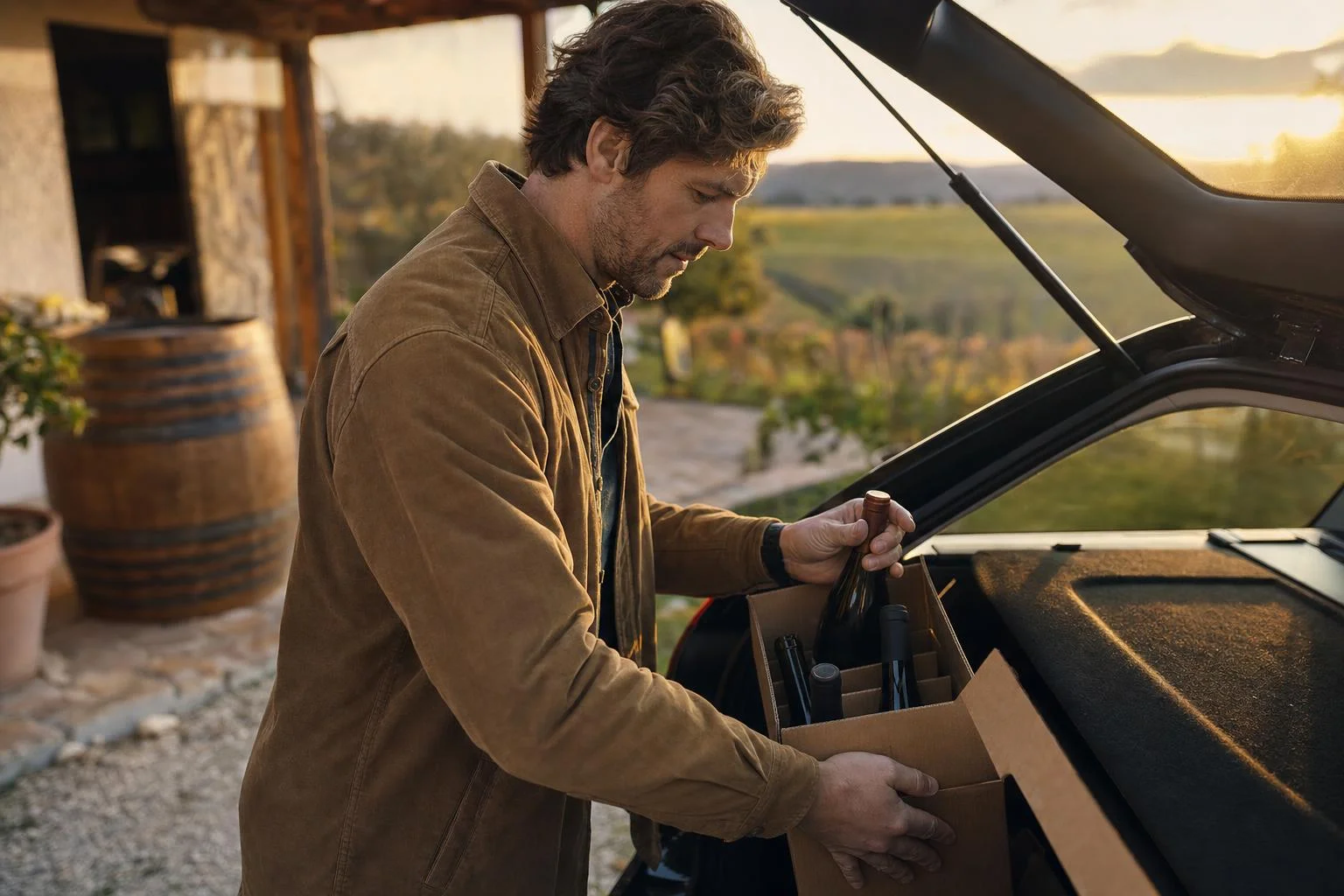
You're standing in a cellar, you've tasted six different vintages, and you've finally found that one bottle that thrilled you — perhaps even a case of it. The euphoria of discovery quickly turns into a practical question: how do you get it home now, so it survives the journey and you don't run into trouble at the border or the airport? We hear this question on almost every trip we organise, and rightly so, because the answer depends on whether you're travelling by plane or by car, how many bottles you're carrying, whether you're crossing a European Union border, and how sensitive the wine is to temperature and vibration. Below we bring you a detailed, practical overview of all the options, with concrete tips we've gathered through countless guided visits to wineries across Europe.
Carry-on and Checked Luggage on a Plane — What's Actually Allowed
The most common misconception is that you can't bring wine into carry-on luggage at all. The truth is that liquids in carry-on luggage are subject to the 100-millilitre-per-container rule, so a standard 750 ml bottle of wine simply won't pass security screening, no matter how valuable it is. The only exception is wine purchased in a duty-free zone after security screening or during a layover, sealed in a special STEB bag (Security Tamper Evident Bag) — you're allowed to carry such bottles onward, but be careful if you have a connecting flight with additional security screening in a third country, as the bag sometimes needs to be re-checked or even opened.
For everything else, a simple rule applies: wine goes in checked luggage. Most airlines allow the transport of alcoholic beverages in checked luggage without special permission, subject to two restrictions worth knowing. First, alcohol above 70% strength isn't permitted at all, which wine never reaches, so this isn't an issue. Second, for alcohol between 24% and 70% there's a quantity limit (usually up to 5 litres per passenger in original, sealed packaging), while still wine with the usual 11-15% alcohol content is generally not subject to any special restriction beyond the general baggage weight limit.
Practical tip: always check the specific carrier's rules before your trip, as they differ in the details — some low-cost airlines have stricter rules on baggage weight and the number of pieces, so an extra bottle could mean an extra charge. If you're carrying a larger quantity, it's worth booking additional luggage online in advance, as this is almost always cheaper than paying at the counter at the last minute.
Styrofoam Carriers and Protective Packaging — An Investment Worth Making
The biggest enemy of wine in transit is not the alcohol limit but breakage and temperature fluctuations in the belly of the aircraft, where the temperature can be lower than in the cabin, as well as baggage-hold vibrations that can damage the cork or cause micro-cracks in the glass. That is why serious wine lovers almost never pack bottles simply wrapped in clothing inside a suitcase, but instead use specialised styrofoam carriers — modular boxes with compartments for 2, 4, 6 or 12 bottles, which are placed inside an ordinary suitcase or carried as a separate piece of luggage.
These carriers do two things at once: they absorb shocks and vibrations, and they act as insulation that slows down temperature exchange, which is especially important in summer when the airport tarmac can be scorching, or in winter when the cargo hold can be below freezing. Good carriers also have an inner lining that catches any leakage should a bottle break, protecting the rest of your luggage from disaster. Many wineries, particularly those accustomed to tourists, sell such boxes right at the exit of the cellar — it is worth asking before you start looking for a last-minute solution at the hotel.
If you have not brought a carrier from home or bought one at the winery, an improvised solution is air-filled packing cushions, thick towels or clothing wrapped around each bottle individually, with the bottles kept apart so that glass never touches glass. Always pack the bottles upright, or at least with the cork facing up if possible, and place them in the middle of the suitcase, surrounded by soft clothing on all sides — never right at the edge or bottom, where the impact is most direct.
Shipping a pallet or case through the winery itself
When the quantity is larger — say you have fallen in love with a vintage and ordered a case of six or twelve bottles, or even part of a pallet — carrying it in your luggage becomes impractical and expensive. Serious wineries that regularly host foreign guests have established partnerships with freight-forwarding companies and offer to arrange delivery directly to your home address. This is almost always the safest option for larger quantities, as pallet transport uses professional packaging with compartments, palletisation and controlled transport conditions.
Before agreeing, be sure to ask concrete questions: who bears the excise duty and VAT in the destination country, what the expected delivery time is (for international wine shipments this is often four to eight weeks due to customs procedures), whether the shipment is insured against breakage, and whether the transport cost is included in the offer or charged separately according to weight and distance. Some wineries have fixed arrangements with courier services specialising in wine, while others simply hand the parcel over to standard post — the difference in reliability is enormous.
It is also important to understand that there are countries with very strict alcohol import regulations where a private individual may not receive a wine shipment at all without an import licence or an intermediary holding the appropriate licence — this applies in particular to some Scandinavian countries with a state alcohol monopoly, as well as to the United States, where the rules vary from state to state. Always check this before ordering a larger quantity, so that the shipment is not returned to the sender or held at customs with additional costs.
Customs and excise borders within the European Union
If you are travelling by car or by plane within the European Union — say, from Croatia to Italy, France or vice versa — wine purchased for personal consumption is not subject to customs duty or additional excise duty, since the excise duty has already been paid in the country of purchase and goods circulate freely within the EU's internal market. This applies to reasonable, 'private' quantities that are clearly not intended for resale. The indicative reference levels that customs authorities use to distinguish personal from commercial consumption are approximately 90 litres of still wine per person, which is more than enough for any enthusiastic traveller.
What is worth bearing in mind is that this freedom applies to movement within the EU, but not when wine enters the EU from outside or leaves it. If, for example, you are returning from Switzerland, the United Kingdom or a country outside the Union, the import rules of the specific destination country apply, including duty-free limits (typically around 4 litres of still wine per passenger in most European systems, although figures vary) and the obligation to declare any excess at the customs desk.
For travellers from Croatia it is worth mentioning in particular that, since joining the EU and the Schengen area, transporting wine to and from the rest of the Union is genuinely simple — no border controls, no declarations, no excise stamps to look out for. This is one of the practical reasons why travelling through the wine-growing regions of continental Europe from Croatia is easier today than ever, and why more and more guests choose to bring home a case or two instead of limiting themselves to a single bottle in their suitcase.
Leaving the EU — what to pay attention to
The situation changes as soon as wine crosses the external border of the European Union, whether you carry it in your luggage or the winery ships it. Every country outside the EU has its own rules on the quantity allowed duty-free and excise-free, as well as its own rules on mandatory declaration. The United States, for instance, formally allows the import of wine for personal use, but individual states have their own alcohol regulations that may differ from federal customs rules, so it is worth checking the regulations of the specific destination state before your trip.
The United Kingdom, since it is no longer part of the EU, applies its own system of duty-free allowances for travellers arriving from the EU — currently in the order of 18 litres of still wine per person without paying duty, but the figures change, so check the current limits before travelling. If you are flying to a destination outside Europe, be sure to also check the import rules of the destination country, as some Asian and Middle Eastern countries have very strict restrictions or even a complete ban on bringing in alcohol for private individuals.
The golden rule for all border crossings outside the EU is: when you are not sure whether your quantity exceeds the permitted threshold, declare it at customs. Undeclared goods above the permitted quantity can mean confiscation of the goods and a fine, while voluntary declaration usually means only paying the difference in excise duty and VAT on the spot, with no further consequences.
Storing wine after arriving home
The journey has been successfully completed, the bottles have arrived intact — but the story doesn't end there, because wine that has travelled for hours under changing conditions of temperature and vibration needs time to 'settle' before you open it or put it away for longer storage. It is recommended to leave the bottles standing undisturbed for at least seven to ten days at their storage location before opening them, especially if it is an older or more serious wine with sediment — vibrations cause the sediment and aroma compounds to be temporarily stirred up, and the wine needs time to stabilise again.
For the storage itself, the usual rules of good practice apply: a stable temperature between 12 and 16°C, without sudden fluctuations, relative humidity of around 60-70% so the cork doesn't dry out, absence of direct sunlight and vibration, and bottles laid horizontally if they have a natural cork stopper, so it stays moist and swollen, preventing air from entering. If you don't have a dedicated cellar or wine fridge, the coolest and most stable room in your home — often a pantry or the bottom of a cupboard away from radiators — is a better option than the kitchen or near a window.
Wines intended for quick consumption, that is, those you plan to drink in the coming months, don't require special care beyond avoiding heat and light. But if you have purchased something more serious at the winery with ageing potential — a big red wine, a special reserve or archive bottling — it's worth considering a professional wine fridge or even a wine storage service offered by some specialised companies, especially if you plan to keep the bottle for years before opening it.
Caring for wine doesn't end with a tasting in the cellar — a true connoisseur knows that the journey home deserves just as much attention as the choice of bottle itself. That's exactly why we include practical advice on packing, transport and possible shipping in every one of our itineraries in advance, so that during your journey you can devote yourself solely to enjoyment, not logistics. If you're planning a visit to the wineries of Istria or elsewhere in Europe and would like someone to think through every detail in advance, including the safe delivery of your favourite bottles home, get in touch with us — we'll be happy to design a journey and solution tailored exactly to your wishes.
Frequently Asked Questions
How many bottles of wine am I allowed to bring on a plane?
In hand luggage, practically none (except duty-free with a special bag), while in checked luggage most carriers allow several bottles of still wine without special permission, subject to general weight limits and the number of luggage pieces — always check your airline's rules.
Do I have to pay customs duty on wine I'm carrying from one EU country to another?
No, within the European Union wine for personal consumption is not subject to additional customs duty or excise tax, since it has already been paid in the country of purchase, as long as it is a reasonable, non-commercial quantity.
Is it safer to ship wine by post or carry it yourself?
For one to a few bottles, carrying them in well-protected luggage is simpler and faster; for larger quantities, organised delivery through the winery with professional packaging and shipment insurance is the safer option, although slower due to customs formalities when exporting outside the EU.
How long does wine need to 'rest' after travelling before opening?
It is recommended to wait at least seven to ten days for the wine to stabilise after the vibrations and temperature changes during travel, especially for older wines with sediment.
Planning a visit to wineries and want to be sure your favourite bottles arrive home intact and without a customs headache? Get in touch with your ideas and dates, and we'll design a journey that includes that detail too.
Request a quote